
Fintech Cloud Migration: When Your Foundation Decides Whether People Trust You
In most industries, an outage produces customer complaints. In financial services, it produces something far more expensive: eroded trust, and the attention of a regulator. That is why a fintech cloud migration carries different weight than an ordinary one. What moves is not just an application. It is the transaction record, the audit trail, and the promise you made to users that their money is safe.
PT Indonesia Digital Exchange understood this well. When they reviewed their technology foundation, the question was not whether the systems still worked. It was whether the foundation was strong enough for the next stage of scale, and tidy enough for anyone to inspect.
Where DEX stood before working with Casa5
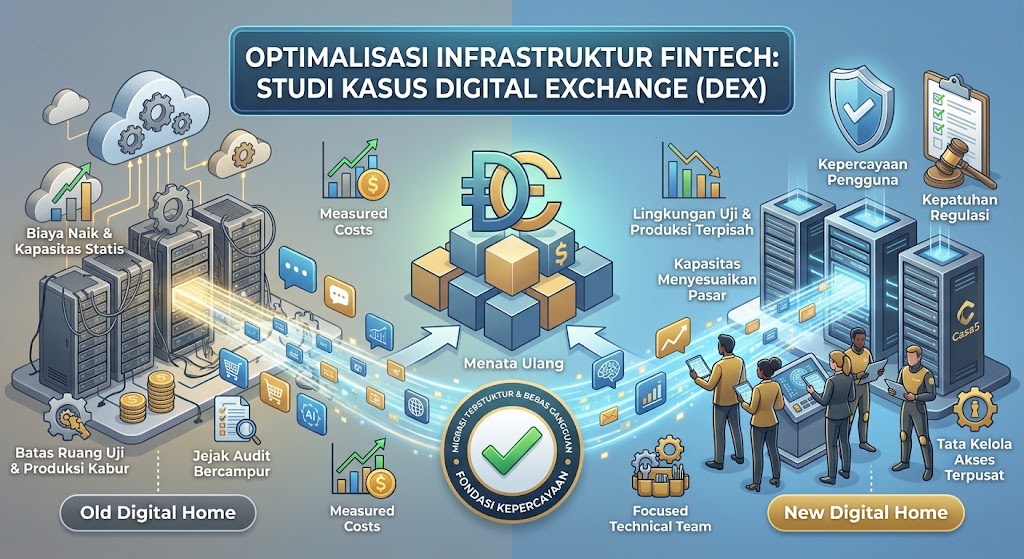
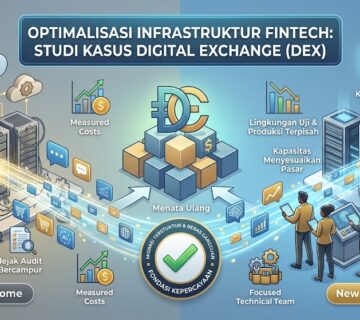
The platform ran with its previous cloud provider, held back by four limitations that fed into one another.
Costs climbing, capability flat
This was the trigger. Infrastructure spend kept rising year on year with no matching gain in capability, and the questions coming from the finance side were getting harder to answer.
Capacity that ignored how markets behave
Workload on a digital asset exchange is dictated by the market, not by office hours. When the market moves, traffic can multiply several times over within minutes.
Statically sized capacity is always wrong in that situation. Too much when it is quiet, too little exactly when it matters.
A blurred line between testing and production
Without firm separation, every change carried more risk than it needed to. Tracing the source of a problem also took longer, because the evidence was mixed together.
The burden of proving compliance
In a closely supervised industry, being able to show who accessed what and when is not a bonus. It is table stakes. The more entangled an environment is, the harder that proof becomes.
How Casa5 approached this fintech cloud migration
Map before moving
The first fortnight went into understanding the system as it actually was, through interviews and hands-on tracing with the DEX team.
On a financial platform, the order in which you shut a service down and bring it back up is not a small detail. It determines whether the transaction record stays intact. That mapping is what made the move something we could plan rather than improvise halfway through.
Turn the findings into business decisions
Those findings became a cost projection for the year ahead, right-sizing recommendations, and a phased move plan. All of it was presented to and approved by the business owners before execution began.
Reorganise the house, not just relocate it
This was the most consequential decision in the project.
Rather than move everything across as-is, we designed a firm separation between the testing environment and the production environment, with centralised access governance on top.
The consequence is concrete. A mistake made in the testing space is structurally incapable of touching the systems serving real users. For a financial company, that is a risk reduction you can put in front of an auditor.
Use the test environment as a dress rehearsal
The move happened in stages, and the testing environment went first.
Not because it was easier. Because it meant every surprise got found and resolved somewhere safe, before production was ever touched.
Stay until transactions flow again
The final phase covered a controlled halt to transaction activity, full system validation, and then the switch of user traffic. Our team stayed with it until service was back to normal.
Before and after: what genuinely changed
| Area | Before | After working with Casa5 |
|---|---|---|
| Where data lives | With the previous cloud provider | Onshore in Indonesia, closer to users and better aligned with compliance needs |
| Capacity when markets move | Static: surplus when quiet, short during spikes | Adjusts automatically to real demand |
| Database resilience | Self-managed, with no standby ready | Managed, with a standby layer ready to take over |
| Environment separation | Boundary was blurred | Fully separated, so the risk of a change stays in its own room |
| Access governance | Scattered | Centralised, with a trail that can be followed for audit |
| Cost structure | Rising without matching gains | Tracks usage, with projections that can be calculated |
What was left behind
The most valuable part of this project is not the move itself. It is the structure it left in place.
DEX now has a foundation that clearly distinguishes the space for trying things from the space for serving users. They have access governance they can present on request. And their capacity follows the market rather than the reverse.
For a company whose licence to operate rests on trust, those three things are not merely technical improvements. They are quantifiable reductions in business risk.
Every fintech cloud migration we take on ends up turning into this kind of structural question sooner or later. For a financial company starting from a blank page instead, the approach looks quite different. There is an example of that in our case study on building cloud infrastructure for Kirimo.
As with our other engagements, a partner funding programme combined with Casa5’s investment meant the professional services cost to the client was zero. They pay only for the cloud services consumed.
Questions we get asked
Does financial data have to be stored in Indonesia? It depends on the data type and which regulator supervises you, so it is worth confirming with your compliance team. What is clear is that keeping data onshore simplifies a lot of conversations, and that option no longer costs you capability.
Does the service have to stop during migration? There is a controlled pause at the final switchover, and on a transaction platform that pause is deliberate, because it protects data consistency. Its duration is planned, announced, and kept as short as possible.
Why does the test environment need full separation? Because separation caps the damage a mistake can do. If testing and production share a home, one misconfiguration can reach real users. If they are separated, it cannot.
In financial services, the technology foundation always ends up being a question about trust. Casa5 handles cloud migration for workloads that cannot afford to be wrong, including those under regulatory supervision. If you are weighing a similar move, let’s talk.

No comment