
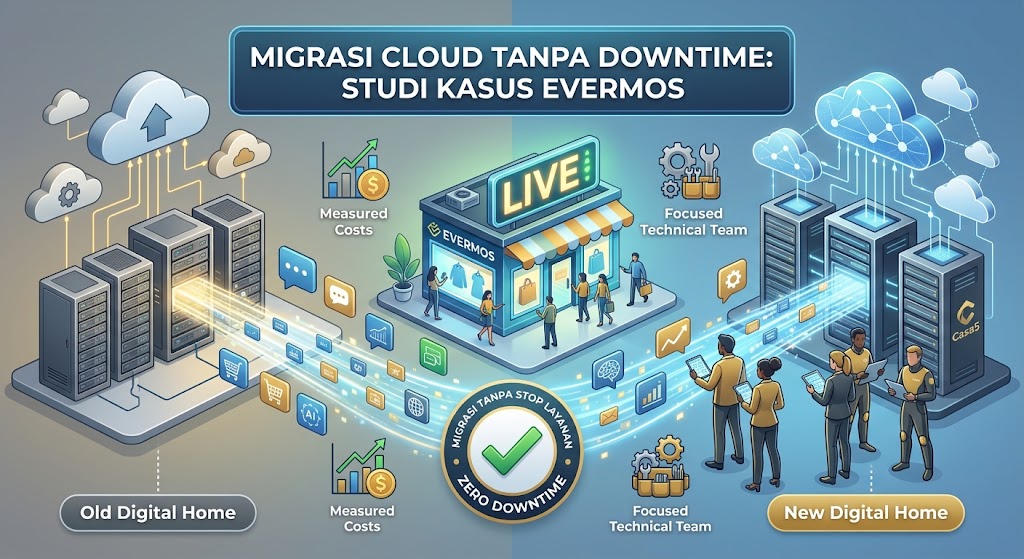
Cloud Migration Without Downtime: How Evermos Moved House Without Closing the Shop
Whenever we sit down with a company to discuss a cloud migration without downtime, the first question is almost always the same. How long will our service be dead?
It is a fair question. When your revenue arrives through an app, an hour of downtime is not a technical matter. It is lost income and disappointed customers.
Evermos had exactly that worry. The difference is that they chose to deal with it before it became a problem rather than after.
Where Evermos stood before working with Casa5
Everything Evermos ran digitally lived with a single cloud provider, in a single location, with no meaningful fallback.
While conditions stayed normal, nothing felt wrong. Systems ran, customers were served, the team slept fine. The cracks only showed once four questions got asked out loud.
“If that location goes down, what is our plan?”
There was no reassuring answer. Every service depended on the same single point, and nothing was standing by to take over.
“What should this actually cost?”
Capacity had been sized by estimate. Some resources sat idle for months while others ran short at the worst possible moment. Without measurement, there was no basis for judging what was excessive.
“How can the team experiment safely?”
Evermos was actively building AI capabilities for internal use. The trouble was that the experimental workloads and the systems customers depended on shared the same space. That forced the team into a choice: move carefully, or move fast.
“Who takes care of all this?”
The engineering team. And every hour spent maintaining infrastructure is an hour not spent building product.
How Casa5 runs a cloud migration without downtime
We did not move anything right away. The first two weeks were spent deliberately moving nothing at all.
Map it first, touch it second
Working alongside the Evermos team, we mapped what was actually there. Which services were running, which ones depended on each other, which ones genuinely mattered to the business, and what the whole thing had been costing.
The output was not a thick technical document. It was decision material: a projected cost of ownership for the year ahead, right-sizing recommendations, and a move sequence ordered by risk rather than convenience.
That plan went to the business owners first. Execution started only after they signed off.
Build the new house while the old one stays occupied
This is the part that makes a cloud migration without downtime achievable in practice.
The old systems kept serving users while the new environment was prepared behind the scenes. Data was copied and continuously synchronised rather than hauled across in one go at the end. As a result, the cutover changed character entirely, from a nerve-wracking leap into a scheduling decision.
We put it in the quietest hours, kept the disruption window as short as it would go, and had a rollback ready in case something drifted.
Divide responsibility clearly
Casa5 owned the build and the execution outright. Validation and final approval stayed with Evermos.
That split was deliberate. The technical weight sits with us, business control stays with the client.
Before and after: what genuinely changed
| Area | Before | After working with Casa5 |
|---|---|---|
| Service resilience | Resting on one location | Spread across more than one location, so a single failure does not stop the business |
| Basis for cost decisions | Estimates and old habits | Cost and capacity analysis grounded in real usage |
| Room to innovate | Experiments mixed in with production | A separate development space, so the team can try things without endangering customers |
| Governance | Limited activity trail | Comprehensive logging as an audit foundation |
| Engineering focus | Absorbed by routine maintenance | Maintenance burden shifted to the platform |
| Documentation | Scattered and inconsistent | Properly documented and usable by the internal team |
What was left behind after our team packed up
The most underrated part of any transformation project is what remains once the vendor finishes.
Evermos did not simply end up with a sturdier foundation. They gained a genuine understanding of their own cost and capacity, something that had never been formally measured. They also gained a clear boundary between the space for trying things and the space for serving customers.
On top of that, they now have documentation that makes the next technical decision faster to reach.
The same underlying worry shows up in other industries in different clothing. In ticket sales, for instance, the issue is not day-to-day resilience but one specific busy minute, which is the story in our case study on cloud for traffic spikes.
One more thing worth saying plainly. Because this project ran through a partner funding programme combined with Casa5’s own investment, the professional services cost to Evermos was zero. They pay only for the cloud services they actually consume.
Questions we get asked
Is a cloud migration with truly zero downtime possible? Absolutely no interruption is rarely realistic, and we would rather be honest about that. What can be promised is a disruption measured in minutes, scheduled for the quietest hour, and backed by a rollback plan. For most businesses, customers never notice.
How long does a cloud migration usually take? It depends on how many systems there are and how tangled they are with one another. What is consistent is the initial mapping stage, which takes about two weeks and does more than anything else to determine how smoothly the rest goes.
What if our documentation is a mess? Very common, and not an obstacle. It is precisely why the mapping stage exists. Some clients tell us the documentation that comes out of it was worth the whole engagement on its own.
When infrastructure starts putting a ceiling on your plans, that is usually the signal to review it rather than wait it out. Casa5 is a Jakarta-based technology partner that guides Indonesian companies through cloud migration from planning through to operations. Tell us where you stand via our contact page.

No comment