
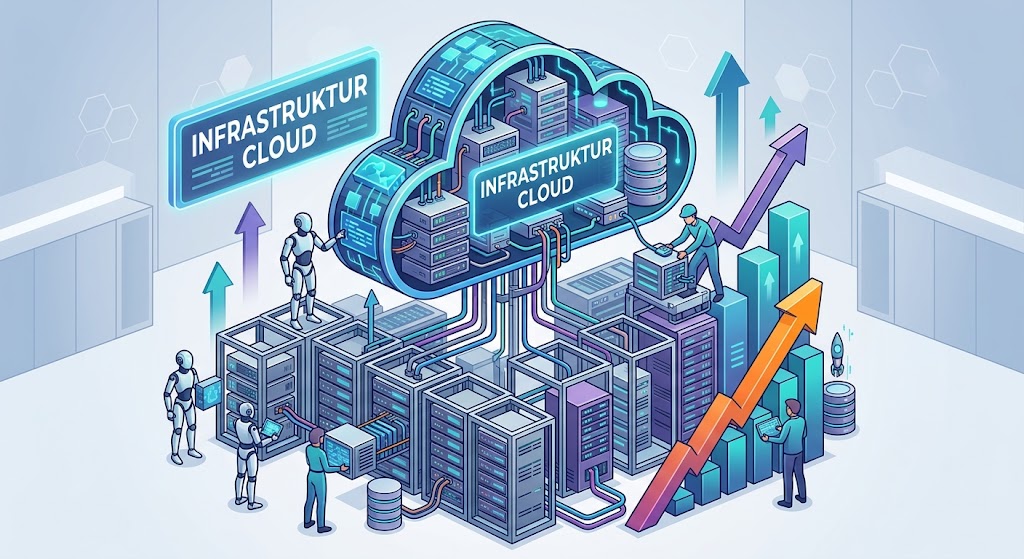
Building Cloud Infrastructure Before Growth Arrives, Not After
Most companies fix their infrastructure after something breaks. Kirimo took the opposite route building cloud Infrastructure before something breaks. Kirimo is a financial technology company offering instant money transfers through the Kirimo.co platform, serving both personal and business needs. The promise is simple: fast, transparent, secure. The ambition is not simple at all, which is to become a significant player in Southeast Asian digital payments.
Ambition like that always comes back to foundations. When the Kirimo team assessed their own position, they found five things that needed settling first. That is where the work of building cloud infrastructure properly began.
The five constraints Kirimo brought to the table
Capacity that capped the roadmap
Transaction volume kept climbing, and payment traffic is never flat. There are seasonal surges and there are busy hours. Every expansion plan ran into the same question: can the system handle it?
Availability risk left uncovered
A money transfer service has to be available around the clock. Meanwhile, the fallback and disaster recovery arrangements were not up to it.
In this industry, an hour of downtime costs you three things at once: revenue, compliance standing, and user trust. Each has a different recovery cost, and the last one is the most expensive.
The burden of proving security
Operating in a closely supervised sector, Kirimo needed data protection and audit capability it could demonstrate, not merely assert in a document. The existing foundation was not fully aligned with standards that keep moving.
Team time swallowed by routine work
Monitoring, capacity adjustment, patching, all done by hand. Hours spent there are hours not spent building the product.
Spend that had no relationship to usage
Surplus resources when traffic was thin, then shortfalls when transaction spikes hit. Wasteful and unreliable at the same time, which is the worst combination a payments company can have.
How Casa5 went about building cloud infrastructure for Kirimo
Unlike a migration project, the Kirimo engagement started from a blank page.
That is a significant advantage and we made use of it. There were no old compromises to preserve simply because that is how things had always been. Every decision came from what Kirimo needs today and where they expect to be next.
Design for all five constraints at once
The new foundation was designed so that each of the problems above is answered within a single coherent design. Patching them one at a time later usually costs more, and the result is rarely tidy.
Define what success means up front
Rather than declaring a project complete, we and the Kirimo team agreed on concrete test scenarios we could verify together.
Which means done meant proven, not installed.
Split the roles clearly
Casa5 took full responsibility for building and operating the foundation. The Kirimo team kept ownership of the application layer and their own release process, with support from our engineers where needed.
That split was intentional. The foundation gets solid without Kirimo’s team losing command of their own product.
Stay on after the system goes live
The project did not end at launch. There was a post-launch support period, a handover, and documentation.
The reasoning is practical. Real problems tend to surface only once genuine user traffic starts flowing.
The whole sequence was completed in 30 working days.
Before and after: what genuinely changed
| Area | Before | After working with Casa5 |
|---|---|---|
| Handling transaction spikes | Fixed capacity, risk of failure at peak | Capacity adjusts to demand automatically |
| Service availability | Fallback arrangements inadequate | Services and databases spread across more than one location, with automatic failover |
| Security and compliance | Hard to demonstrate on request | Layered protection and an audit trail that can be shown |
| Engineering time | Absorbed by manual monitoring | Routine work taken over by the platform |
| Cost structure | Surplus when quiet, short when busy | Follows actual usage |
| Readiness to expand | A question mark on every plan | A foundation ready to carry new volume and new markets |
What was left behind
Kirimo started from a healthy position. They saw the limits of their foundation before those limits became visible to customers.
The result is that their team can now answer “can we handle it?” with more composure, whether the question comes from an investor, a financial partner, or a regulator.
Day-to-day operational load moved to the platform. Infrastructure spend now moves with the business rather than ahead of it.
We see a similar pattern with other financial clients, though the route differs. If you are curious how the approach changes when the systems already exist and have to be relocated, that story is in our fintech cloud migration case study with Indonesia Digital Exchange.
Through a combination of partner investment programmes and Casa5’s own contribution, the professional services cost to the client was zero. They pay only for monthly cloud consumption.
Questions we get asked
How long does it take to build cloud infrastructure from scratch? For a scope like Kirimo’s, 30 working days. The number shifts with the number of services and how ready the application is, but one to two months is a fair range for a first production foundation.
We are a small startup. Is it too early to think about this? Quite the opposite, and this is our view after several projects. Sorting out the foundation while traffic is still small is far cheaper and far less stressful than sorting it out once you have plenty of users.
Will our own team be able to run it afterwards? That is the goal. It is why handover and documentation sit inside the project scope rather than being an optional extra at the end.
A foundation built right at the start usually looks cheap in hindsight. Casa5 helps Indonesian companies with building cloud infrastructure that is ready to grow and ready to be audited. If your product is heading into that phase, get in touch.



No comment